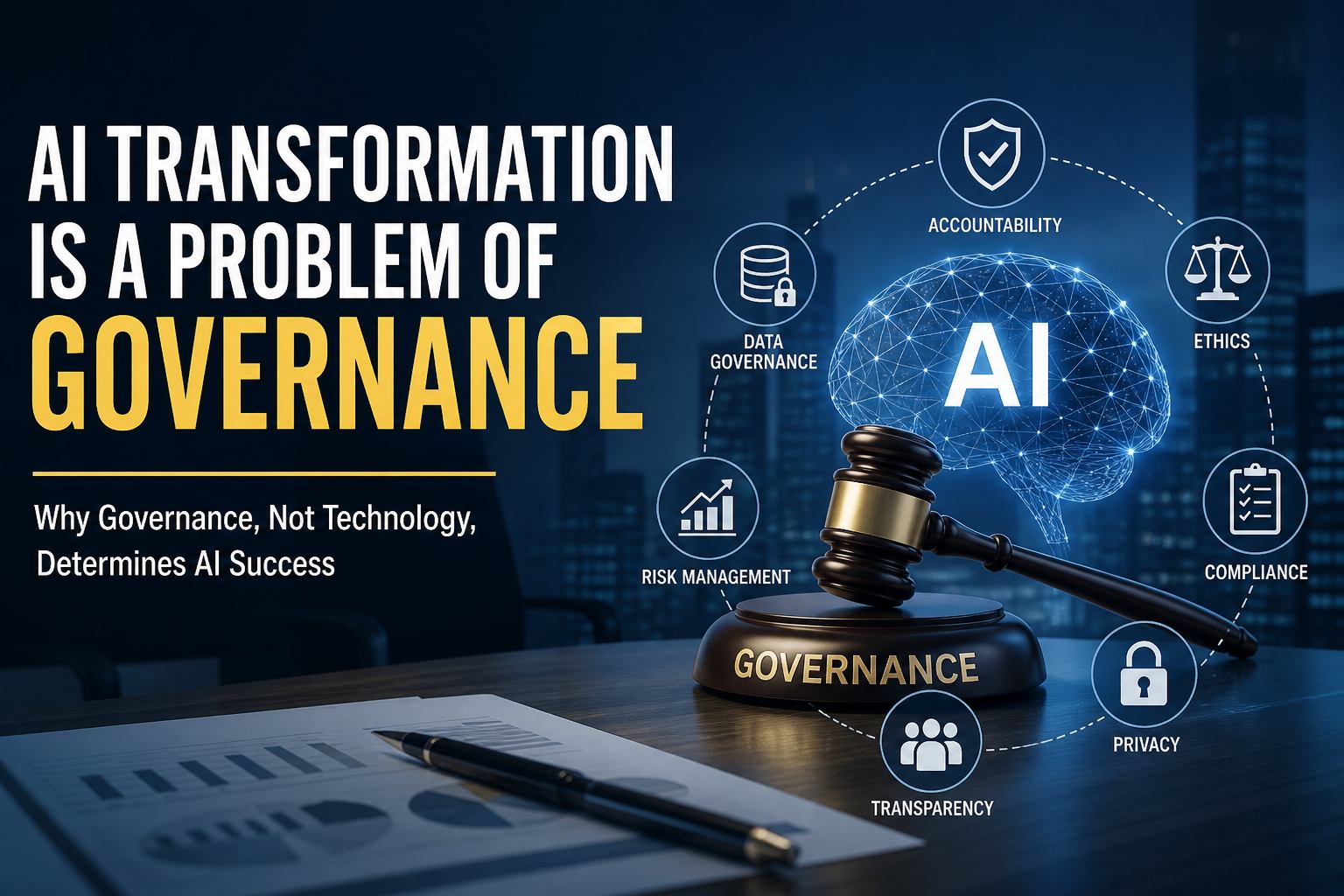
The Real Challenge Behind AI Transformation
We are no longer discussing whether AI will transform organizations. That phase is over. AI has moved from being a support tool to becoming part of the core infrastructure of how companies operate. And yet, most organizations are still struggling—not because of the technology, but because of execution.
In practice, the biggest challenge is not adopting AI—it’s integrating it into real operations. That means redesigning processes, aligning teams across functions and regions, embedding decision-making into new AI-driven workflows, and ensuring consistency at scale. From my experience in complex and multi-region environments, execution is where transformation either succeeds… or fails.

You can have the best tools, the best models, and the best intentions. But without clear governance, operational alignment, and structured delivery, AI becomes fragmented—and value never fully materializes. At the same time, concerns around AI are growing, not only among the public but also among researchers and policymakers, reinforcing the need for governance as both an ethical framework and a practical necessity.
The companies that will lead this next phase are not the ones that adopt AI first. They are the ones that can execute consistently—at scale, across teams, and with clarity. AI is not the challenge. Execution is.
What Is AI Governance?
AI governance is basically the structure around how AI is used in an organization. It includes the processes, standards, and guardrails that make sure AI systems are safe, ethical, and actually under control . It’s not just about building models — it’s about deciding how they should be used, who is responsible for them, and what happens when things go wrong. Without that structure, AI can quickly become risky or unpredictable, especially as it starts influencing real decisions.
At the same time, governance is also what makes AI scalable. It’s not only about avoiding problems — it’s about making AI work consistently across the business. Managing, optimizing, and scaling AI initiatives requires alignment: between teams, data, and objectives . In many cases, the issue is not the model itself, but everything around it — data quality, compliance, or simply lack of coordination. Governance helps bring that together and creates a more stable foundation to build on.
There’s also something more practical to keep in mind: AI is not neutral. It’s built by people, trained on human data, and used in real environments. So naturally, it reflects biases, errors, and limitations. That’s why governance involves more than just technical teams — it requires input from business, legal, and sometimes even external stakeholders. The goal is not to make AI perfect, but to keep it controlled, monitored, and aligned with how the organization actually operates.
Source : AI governance.
Why AI Transformation Fails Without Governance
Technology doesn’t fix organizations. It amplifies them . Over the past few years, AI has been presented as the solution to inefficiency — better forecasts, faster decisions, smarter operations. And yet, across industries, the results are uneven. Many AI initiatives stall, underperform, or quietly disappear after the initial excitement. This is often blamed on the technology: models aren’t mature, data isn’t ready, systems aren’t integrated. That explanation is comforting — and wrong. AI doesn’t primarily fail because of technology. It fails because organizations deploy it without governance.
At its core, AI accelerates decisions. It reduces the time between signal and action. But it doesn’t answer the most important questions: who decides, based on what criteria, within which limits, and with what accountability if things go wrong . When these questions are unclear, AI doesn’t solve the problem — it makes it worse. Poorly governed organizations don’t become efficient with AI. They become faster at doing the wrong things. Governance is what defines boundaries, clarifies ownership, and forces trade-offs. Without it, decision-making remains unclear, and AI simply scales that confusion.
This is why governance matters in practice. Without it, risks become harder to control — bias, privacy issues, and operational failures don’t disappear, they spread faster. Compliance becomes reactive instead of proactive. Trust erodes because decisions are opaque. And even innovation suffers, because teams operate without clear rules or direction. At the same time, governance itself is not easy. It has to balance control and flexibility, adapt to evolving regulations, manage data complexity, and deal with real challenges like bias and explainability. But without it, AI transformation doesn’t fail slowly — it fails at scale.
Why AI Is a Governance Problem (Not a Technical One)
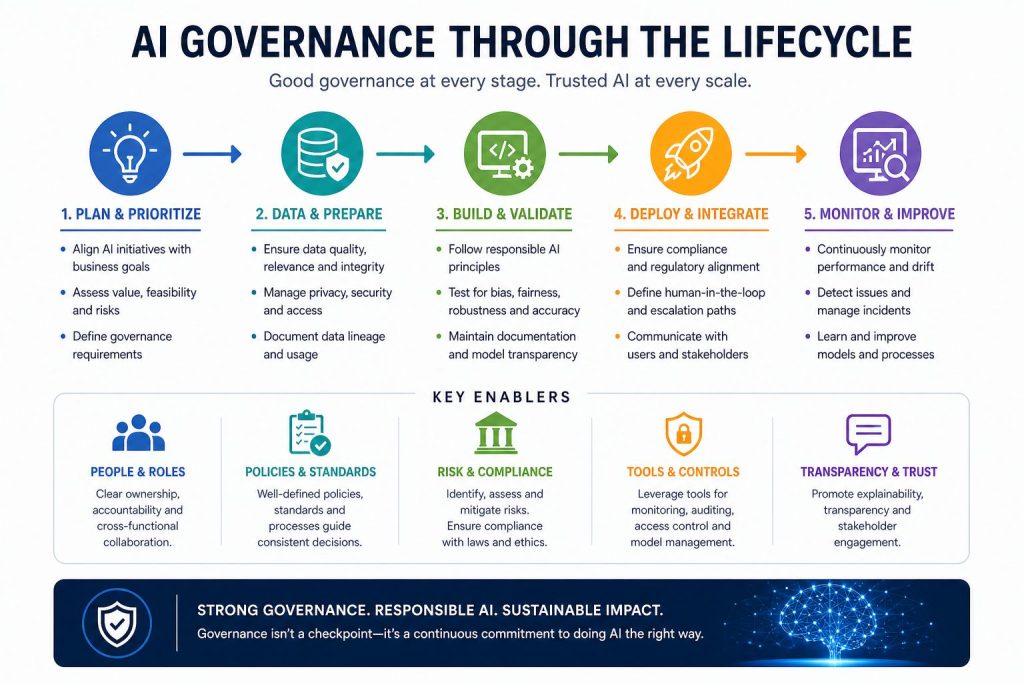
AI is often treated as a technology problem. Better models, better data, better tools. But in reality, AI doesn’t change what an organization does — it changes how fast it does it. It accelerates decisions, shortens feedback loops, and pushes actions through the system faster than before. And that’s exactly where the problem starts. Because speed without structure doesn’t create value. It creates confusion, just faster.
At its core, AI doesn’t decide anything on its own. It surfaces signals, patterns, and recommendations. The real questions remain the same: who has the authority to act, on what basis, and within which limits. When those elements are unclear, AI doesn’t fix the problem — it amplifies it. Where accountability is weak, AI makes it easier to hide behind the system. Where priorities are unclear, AI optimizes the wrong things more efficiently. The issue is not the model. It’s the lack of decision discipline around it .
This is why AI is fundamentally a governance problem. Not because governance slows things down, but because it creates clarity. It defines boundaries, makes ownership visible, and forces explicit trade-offs. In an AI-driven environment, that clarity becomes critical. The faster decisions happen, the higher the cost of getting them wrong. Organizations that treat AI as a technical upgrade miss the point. The real challenge is structural — aligning decision-making, accountability, and strategy so that AI actually drives the right outcomes.
Key Components of an Effective AI Governance Framework
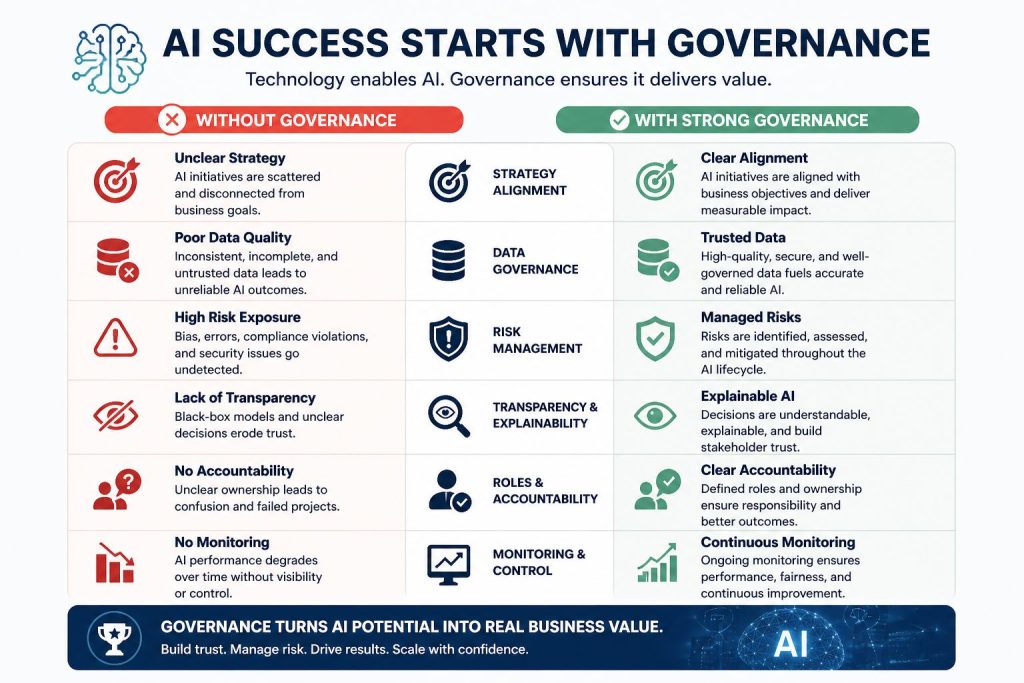
If governance is the problem, then the question becomes simple: what does “good governance” actually look like in practice? Not in theory — but inside a real organization. Because in most cases, the issue is not that governance doesn’t exist. It’s that it’s unclear, fragmented, or disconnected from how decisions are actually made.
The first component is clarity. Who owns AI decisions? Who is accountable when something goes wrong? Governance needs to define decision rights, not just processes. Without that, everything else becomes noise. The second component is boundaries. What are the non-negotiables — in terms of risk, compliance, ethics, or cost? AI systems need constraints, otherwise they will optimize in directions that don’t make sense for the business.
Then comes consistency. AI cannot scale if every team uses different data standards, different rules, or different assumptions. Governance frameworks create shared practices — around data quality, model usage, validation, and deployment — so that AI can move across teams and regions without breaking. This is what allows organizations to move from isolated use cases to something that actually works at scale.
Finally, there is monitoring and adaptation. AI systems are not static. They evolve, drift, and sometimes fail in unexpected ways. Governance needs to include mechanisms to track performance, detect bias, ensure compliance, and adjust when needed. Not once — but continuously.
In the end, an effective AI governance framework is not about adding layers of control. It’s about making decisions clearer, boundaries explicit, and execution consistent. Without that, AI doesn’t scale. It fragments.
How to Fix the Governance Gap in AI Transformation
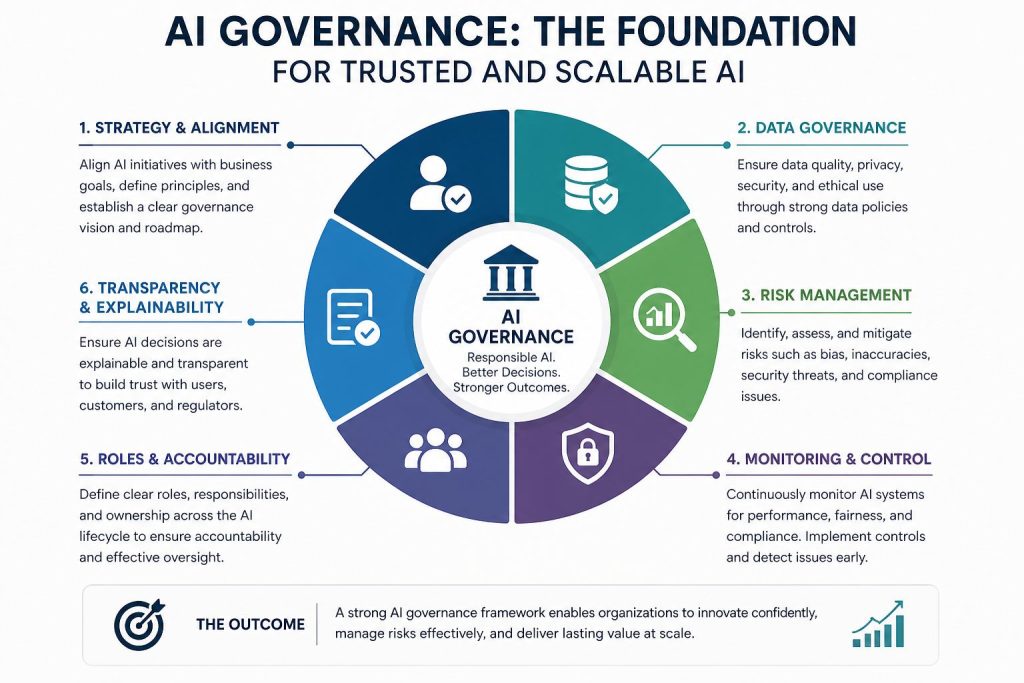
If governance is the issue, then fixing AI transformation is not about adding more tools — it’s about fixing how decisions are made. Most organizations don’t lack AI capabilities. They lack clarity. Before scaling anything, there needs to be a clear understanding of what decisions AI is actually supporting, who owns those decisions, and what boundaries cannot be crossed. Without that, AI will create speed — but not direction.
The first step is not technical. It’s structural. Organizations need to define decision ownership and align teams around it. In many cases, the problem is not data or models, but the fact that responsibilities are unclear or shared in a way that avoids accountability. Governance starts by making ownership explicit, even if that creates friction at first. Because without ownership, there is no real control.
The second step is to build governance into the process early — not after deployment. This means defining policies around data usage, risk, compliance, and acceptable outcomes before AI systems are scaled. It also means setting up simple but clear mechanisms to monitor performance, detect issues like bias or drift, and act when thresholds are crossed. Governance should guide execution, not slow it down.
Finally, governance has to evolve. AI systems change, regulations change, and organizations change. What works today won’t hold tomorrow. Fixing the governance gap is not a one-time effort — it’s a continuous process of adjustment. The goal is not to create a perfect framework, but a usable one. One that keeps decisions aligned, risks visible, and AI connected to real business outcomes.
Conclusion – Governance Is the Missing Piece
At this point, the pattern is clear. AI is not failing because the technology isn’t ready. It’s failing because organizations are not ready to use it properly. The gap is not in models, data, or infrastructure — it’s in how decisions are structured, owned, and controlled. Without that foundation, AI doesn’t create value. It creates noise, speed, and sometimes risk.
What AI really does is expose how an organization works. If decision-making is unclear, AI makes it more visible. If accountability is weak, AI makes it easier to avoid. If priorities are unstable, AI will optimize the wrong things faster than ever. In that sense, AI is not fixing anything — it’s revealing what was already there.
That’s why governance is not a secondary concern. It’s the starting point. The organizations that succeed with AI will not be the ones with the most advanced models, but the ones with the clearest decision frameworks. Governance brings clarity, defines boundaries, and makes execution consistent. Without it, AI remains fragmented. With it, AI becomes a real driver of transformation.